
Today, we begin our annual four-part pro-life series. One time, my friend Stephanie Gray was talking to a teenager named Mark. He asked, “What if you have a 12-year-old girl, raped by her father, pregnant with a deformed fetus, and she is going to die?” To give a good answer, Stephanie said: Can I ask you: ‘Is there anyone who inspires you?’ Mark told her about a wrestler he knows. She asked, ‘Did he have to work hard? Give up things he wanted to do?’ ‘Yes.’ ‘Tell me more about him.’ Mark said he had many tragedies in life, like relatives committing suicide. They kept on talking as Stephanie was trying to give pro-life truth and pro-life compassion. Then she said, “I asked you all that because when you brought up the difficult circumstances a pregnant 12-year-old could be in, what I really heard you saying is, ‘What if someone is in a really hard… situation?’ You just told me about someone who inspires you who faced… tragic situations… You told me he inspired you, not because his life was free of difficulty… but… because of how he responded. He didn’t end a life… but… sought to make something out of the life he had… It wasn’t easy, but he did the right thing. That’s all I ask you to consider with crisis pregnancies—that we follow in the footsteps of inspiring people and not end a life … but look for ways to rise above and turn a tragedy into something good” (Love Unleashes Life, 71-74). Because of this, Mark’s demeanor changed from hostility to openness.
The Gospel today says that Jesus “left Nazareth and made his home in Capernaum by the sea, in the territory of Zebulun and Naphtali.” Jesus leaves His home village of Nazareth (map) and goes northeast to the larger town of Capernaum, which will become His center of His ministry for three years. There are two explanations offered for this move, one practical, one spiritual. Capernaum allowed Him more access to people because it was bigger, He could travel across the lake, and it’s close to a Roman road for faster travel. Spiritually, however, St. Matthew gives this interpretation: “so that what had been spoken through the Prophet Isaiah might be fulfilled: ‘Land of Zebulun, land of Naphtali… — the people who sat in darkness have seen a great light, and for those who sat in the region and shadow of death light has dawned’” (Mt 4:13-16). Seven hundred years before Jesus, the Jewish people in this region were the first to be invaded by the Assyrians, and so, seven hundred later, Jesus chose that they would be the first to receive His restoration—tragedy into hope.
Our theme for this year’s series is the Culture of Life compared to the Culture of Death. These phrases come from St. John Paul II, who stated that the culture of life believes every human is sacred (19), while the culture of death has eclipsed the sense of God (21). When we encounter difficulties, the culture of life focuses on hope, while the culture of death is confronted with despair. In this series, I’m trying to tie together subjects we’ve covered in the past: abortion, contraception, in vitro fertilization, and euthanasia. Trying to cover these broad topics will be difficult, so you may disagree. The goal, hopefully, is to see a bigger picture.
Like Mark, many people bring up the question of rape. The cultures of life and death agree this is horrible! The man should be put in prison, the woman supported. Questions: Should we bring back the death penalty for the rapist? Should we give the death penalty to the baby? And can any good come from this terrible situation? Because of Jesus, there are examples of hope.
Have we ever considered that our culture doesn’t show stories like this? In public schools and the mainstream media, we never hear that preserving life is a possible good choice. Our culture says its pro-choice, intending to mean that they don’t force people to choose one way or another, but a story like this that might dissuade someone from choosing abortion is ignored because abortion is the favoured choice.
Dr. Aaron Kheriaty wrote, “I recall… a minor I treated for several years. I first met her when she was hospitalized… after a suicide attempt. The year prior she had undergone an abortion… pressured by her parents… who argued that abortion was her only option… She recalled lying in bed with her hand on her belly, feeling a deep bond… with her unborn child… She stated in clear and cold language: ‘I killed my baby.’ This was a woman raised in a prochoice household… She did not consider herself a religious or pro-life person … Her… regret… stemmed neither from religious values, nor from others accusing her of wrongdoing” (Ryan Anderson & Alexandra DeSanctis, Tearing Us Apart, 85-86). In our culture, there’s no acknowledgement of women who regret their abortions, no support for them in their pain.
A 2011 meta study (Priscilla K. Coleman, Abortion and Mental Health: Quantitative Synthesis and Analysis of Research Published 1995-2009, British Journal of Psychiatry 199, no. 3) surveying 22 studies on abortion and mental health outcomes showed that, for 163,831 women who had abortions, even after controlling for prior psychiatric health problems, anxiety disorders rose by 34%, depression by 37%, alcohol abuse and suicidal behaviours by 100%, marijuana abuse by 200% (Anderson & DeSanctis, 87). Obviously, many women say their abortions don’t bother them. However, the point is that thousands of women say there are negative effects, but our culture won’t address their needs.
When it comes to euthanasia, according to IMDB, the eight most highly rated movies about euthanasia are all stories of people choosing to kill themselves. The mainstream narrative is that euthanasia is the right choice, and so deaths caused by medical assistance keeps on increasing, and in 2024, MAiD accounted for 5.1% of all deaths in Canada.
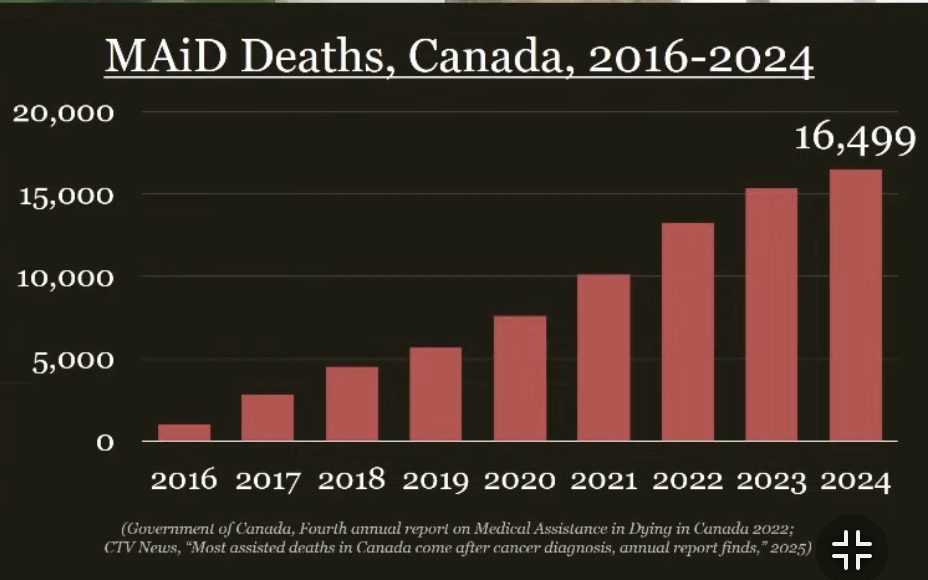
This made the United Nations Committee on the Rights of Persons with Disabilities say it is “extremely concerned” that persons with disabilities will feel they have no other choice but to kill themselves. Once we decide that we can kill someone because they’re already dying, then we can also kill someone who’s in pain, or depressed, (or, as mentioned last year,) has lost his hearing, or someone who is anorexic, or doesn’t want to be evicted can choose MAiD — I believe this is the culture of death.
The media won’t give attention to Nick Vujicic, who wanted to kill himself because he was born without arms and legs, but found life in Jesus and is giving hope to millions;

Photo by Gage Skidmore
or Mark Davis Pickup, who was forced to retire at 38 because of Multiple Sclerosis and has been a warrior against assisted suicide;
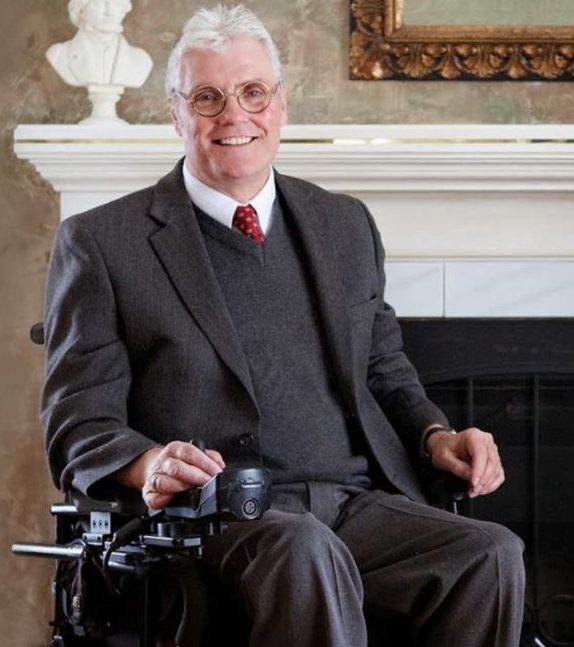
Source: Reframing Ministries
or Nikki Kenward had locked-in syndrome and could only blink her right eye, but later said, “Had someone asked me before… I would have wanted to die. But when I was in hospital, unable to speak, I knew I wanted to live”.

And here are two more people offering hope out of tragedy:
There’s always hope and healing from Jesus. For those who don’t know, we’ve had three people in our parish publicly share their stories of healing after abortion. To anyone who’s been pressured, misled, or has chosen abortion, Jesus says, ‘the people who sat in darkness have seen a great light.’ Jesus loves us and wants to forgive every sin, even abortion.
As soon as He moves to Capernaum, His first public words are: “Repent, for the kingdom of heaven has come near” (4:17). ‘Repent’ in Greek literally means ‘after understanding,’ that is, to think and act differently. Why? Because ‘the kingdom of heaven has come near.’ The kingdom of heaven is a very dense concept, but, to put it simply, the kingdom is God acting in Jesus. God, through Jesus, in the Holy Spirit, is acting in our hearts and calling us to life! This means we need to acknowledge our sins and turn to Him.
As we’ve done every year since 2021, we’re going to show the truth regarding abortion with graphic photos, and this will happen on February 7 and 8, 2026—so this is a notification for all parents with children.
As part of the culture of life, our one invitation is that we sign up for 40 Days for Life, where we pray on church property near B.C. Women’s Hospital where they kill preborn children. We pray for an end to this and for the repentance of everyone involved, and that they find healing and forgiveness in Jesus.
St. John Paul II wrote, “The Gospel of life is at the heart of Jesus’ message… It is the Birth of a Child which is proclaimed as joyful news… but Christmas also reveals the full meaning of every human birth… Jesus says: ‘I came that they may have life, and have it abundantly’” (Evangelium Vitae, 1).