

Today, we’re talking about healing from wounds, because we all have them, and we’re going to draw upon God’s grace from a very sensitive area of healing, that is, healing from sexual wounds and abuse. We’re not going to go into any details, but, because this is one of the worst wounds a person can suffer, seeing what God does in terms of this healing can provide hope for all people.
There’s also a need to speak about healing from sexual abuse because this terrible pain is more common than we think and Jesus wants to heal it. I’ve talked to a number of people who are survivors, asking their feedback about this homily, and they support it. I also sought feedback from the eight parents on the Education Committee of our school and they support it; they said that, if asked, it would create an opportunity for age-appropriate conversations.
In the First Reading, let’s focus on two things God the Father says. First, “Here is my servant… in whom my soul delights… he will bring forth justice to the nations… A bruised reed he will not break, and a dimly burning wick he will not quench” (Isa 42:1,3). This prophesies Jesus, the servant of the Father Who gently comes to us who are in pain, are weak, or are fragile. Second, the Father says to His servant, “I have given you as a covenant to the people… to bring out the prisoners from the dungeon, from the prison those who sit in darkness” (42:6-7). One person wrote me, ‘My heart resonated with these words as they ring true in my healing journey. I can see the connection to Baptism as this sacrament makes us “a new creature.”’
Today, we celebrate Jesus’ Baptism and that He gave us the Sacrament of Baptism to begin a new life. This is our first point: to all people, and in particular, those who have been harmed sexually, Jesus wants to give us new life, life in Him, life to the full. We may sometimes doubt if healing is possible or if God really wants it; there is a temptation to blame ourselves, to think we deserve pain. Let’s be clear: These thoughts are not from God, and He wants to free us from them.
Second point: Experiencing this new life is a long journey. In this book, My Peace I Give You: Healing Sexual Wounds with the Help of the Saints, Dr. Dawn Eden recounts her long story of healing. 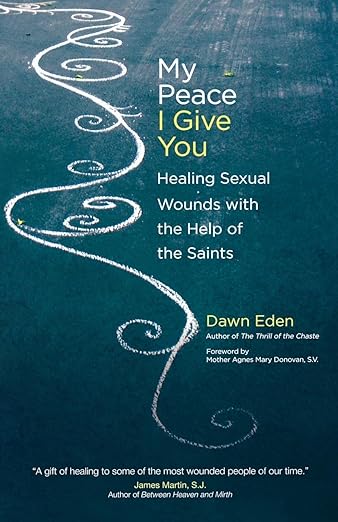 She was sexually abused by a janitor at a Jewish synagogue when she was five. When she was 31, she received the gift of faith in Jesus and realized that He wanted her to be born from above through Baptism, but, while this was encouraging, she admitted that she didn’t feel pure. She went through years of coming closer to Jesus’ mercy, then doubting it; asking questions that seemed to be dead ends, then turning back to Him; talking to her mother about her abuse when she was a child and being blamed, then talking to her mother about it later in life and finding answers. It’s a painful, real, and hopeful story, thanks to God, counselling and therapy, and friendships.
Third point: Jesus came to suffer with us. When Dawn was five, she asked her Jewish parents about Jesus, and they said: If He were God, He would not have been crucified (42)—that’s logical from a certain point of view: God can’t suffer and, because He’s powerful, would never allow Himself to be hurt.

Dawn Eden Goldstein. Photo by Jay Mallin.
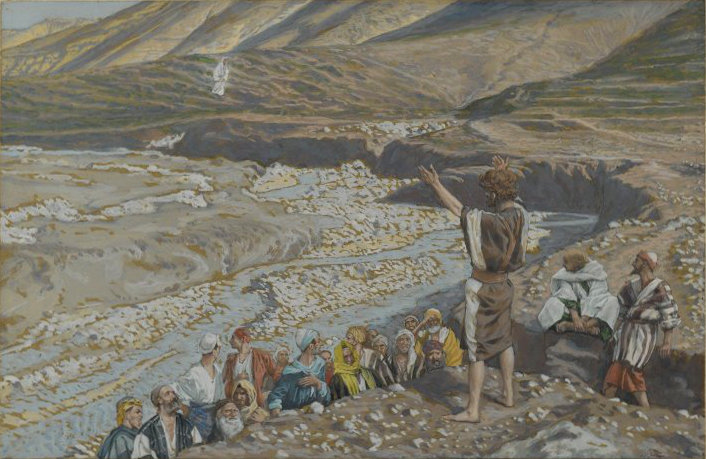
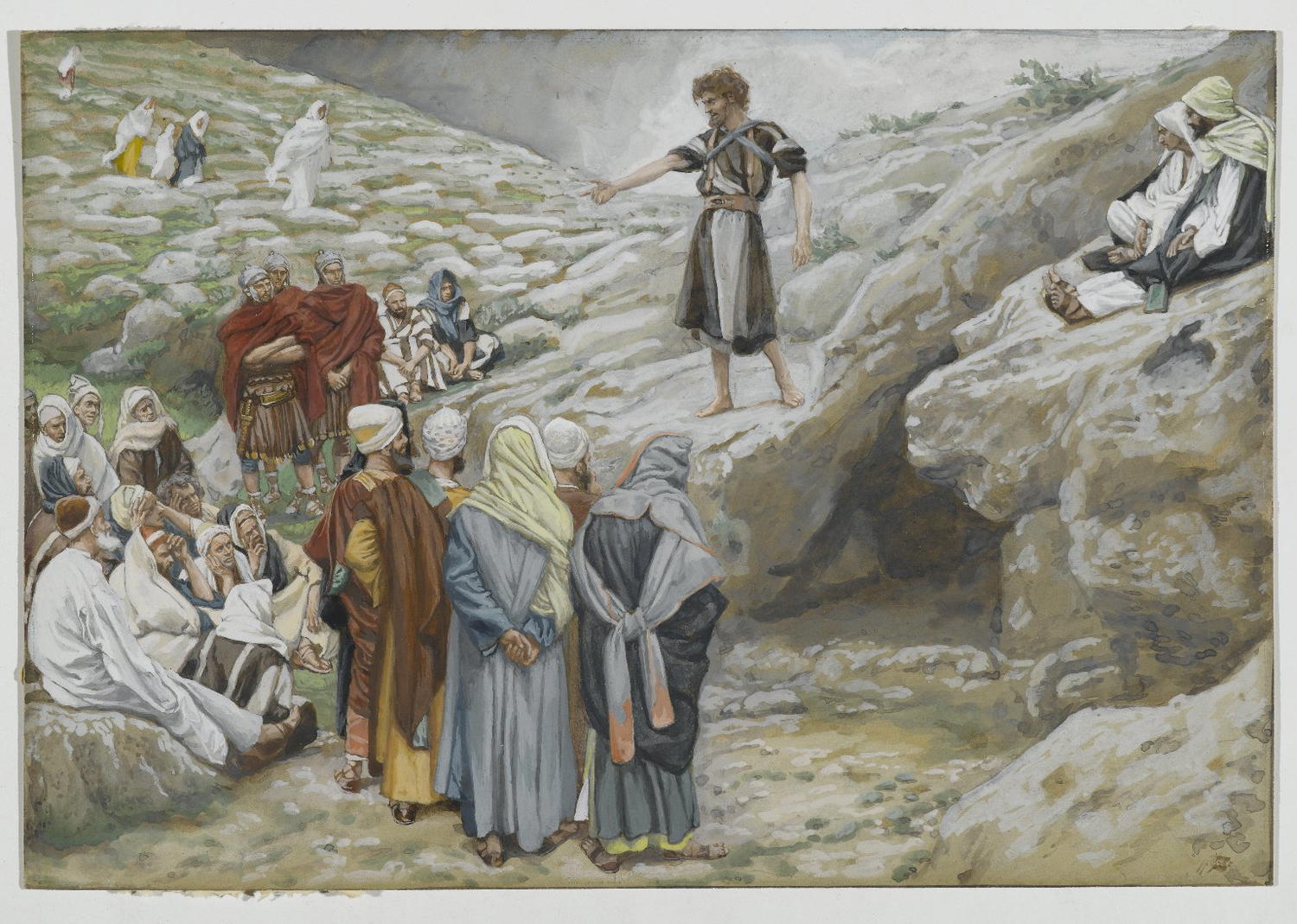
But Jesus revealed the opposite to us on the Cross: His love for us meant He would go so far as to suffer for us. This love was also revealed three years prior through His Baptism. The Gospel says, “Jesus came from Galilee to John at the Jordan, to be baptized by him. John would have prevented him, saying, ‘I need to be baptized by you, and do you come to me?’ But Jesus answered him, ‘Let it be so for now; for it is proper for us in this way to fulfill all righteousness.’ Then John consented” (Mt 3:13-15). For a long time, Christians pondered why Jesus was baptized. John’s baptism was for the forgiveness of sins and He had no sin. So, St. John objects. Jesus gives a mysterious answer, ‘Let it be so for now; for it is proper for us in this way to fulfill all righteousness.’ Righteousness means He only wants what God the Father wants, and the Father wants Him to identify with sinners.
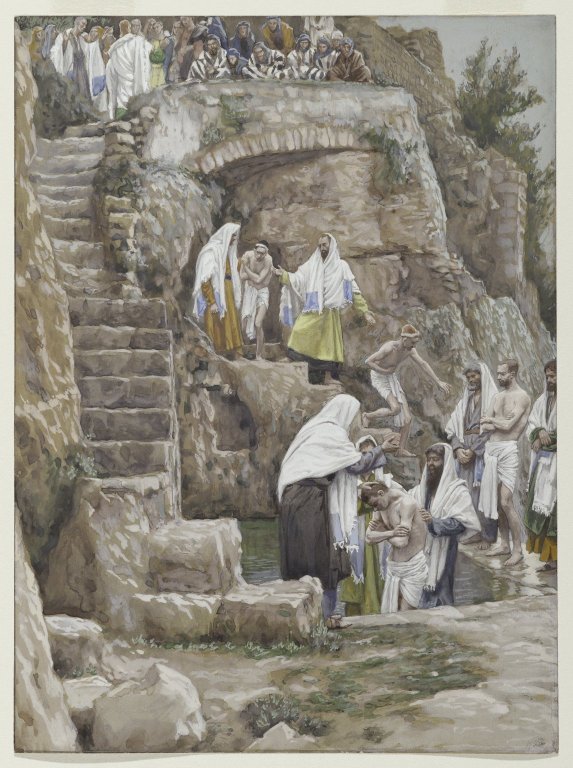
These three paintings help us to understand that thousands of people were going out into the desert to be baptized, sinners publicly confessing their sins and wanting a new life. And then Jesus, God Himself, starts walking among them, blending into and identifying with the crowd, and gets baptized.
-
- All paintings by James Tissot.
Dr. Eden writes, “[Jesus] invites us to be joined with him in baptism because, in the words of [St.] John Paul II, he ‘wishes to be united with every individual, and in a special way he is united with those who suffer’” (42).
An episode from her life helps show what Jesus’ suffering with us means to her. When she was 31, she learned that some people with post-traumatic stress disorders have emotional flashbacks—learning this gave her some relief, because it explained why, a few times a year, she would again emotionally experience her abuse. Simply because of this knowledge, some of her symptoms began to diminish (56). However, one time, in graduate school, she was talking to a professor and said something that seemed to offend him but she didn’t know what; his face darkened and she was too embarrassed to ask, so she quickly left. For her, talking to someone in authority, who then got embarrassed and suddenly changed his behaviour was an emotional trigger. She wrote, “At the bottom of the stairs… I faced a choice. To my right was the library. If I went there, I might be able to distract myself… and suffer on my way home. To my left was the chapel. If I went there, there was no telling how long I would cry and who might see me. With a push, perhaps, from my guardian angel, I turned left. Finding a seat in the back of the chapel, I sank to my knees… As the tears started to flow, I whispered, ‘Dear Jesus, I know I can choose to suffer this with you, or without you. I choose to suffer this with you. Don’t leave me.’ I cried and cried… Yet, upon rising, even as some leftover tears trickled out, I felt different from other times I had suffered flashbacks. For the first time, I felt that, even in my most intimate suffering, I was not alone. In the ancient phrase… ‘God cannot suffer, but he can suffer with.’ When I finally made it back out the chapel door, I could not tell whether those last drops were tears of sorrow, or of joy. Perhaps they were both” (62-64).
In the end, Dr. Eden doesn’t say all her pain is gone, but “the evil of my past is still evil, but it no longer has any power over me” (178).
God willing, these three points (Jesus wants to give us new life, experiencing healing is a long journey, Jesus came to suffer with us) can help give hope and contribute in a small way to healing. If you’d like to give feedback, please do. Keep in mind that we’re not covering every aspect of this topic, but focusing Jesus’ desire to heal.
Also, seeing how adoration helped Dr. Eden’s healing, let’s ponder our parish goal of 500 of us committing to weekly adoration by January 1, 2027. Is this what the Father wants?
The end of the Gospel says, “When Jesus had been baptized… a voice from heaven said, ‘This is my Son, the Beloved, with whom I am well pleased’” (3:16-17). Hopefully, we can all hear these words addressed to us, that we are beloved sons and daughters of the Father. These are words which point to Jesus’ Resurrection and ours.