
In 2009, Karnamaya Mongar arrived in the U.S. as a refugee from Nepal. Pregnant and struggling financially, she chose abortion but died at the clinic of Dr. Kermit Gosnell, whose team administered an excessive amount of a cheap sedative.

Photo released by the Philadelphia District Attorney, 2013
Shockingly, when the clinic informed the Department of Health of her death, the fax was received, then passed up to two women leaders who decided to do nothing, and then the Department’s attorneys told the woman who received the fax to keep silent, and she told a clinic nurse to do the same. Even 17 years before this, the health inspector found Gosnell’s clinic unsanitary but didn’t report it. The National Abortion Federation also wouldn’t certify the clinic, but again didn’t report its problems. Gosnell has been sentenced to life in prison for Mongar’s death and the murders of babies who survived abortions, but the Grand Jury Report wrote, “Gosnell left dozens of damaged women in his wake. His reckless treatment left them infected, sterilized, permanently maimed, close to death, and, in at least two cases, dead.” The point of this story is that he, his wife, his team, state authorities, and abortion regulators all participated in cover-ups because access to abortion was considered more important than women’s health—not what we’d expect from people who are pro-choice and want to help women.
Today is the second of our four-part series on the Culture of Life and the Culture of Death. The goal today is to show how the contraceptive mentality has led to a devaluing of life, and to more abortions, not less; and how abortions have hurt women, not helped; and how in vitro fertilization flows from this lack of respect for life.
Please remember, when we talk about these issues, the point is not to discourage; many of us have had no idea that these things are wrong and why. The point is to seek truth and love. If we’ve done any of these sins, please know that Jesus loves us and came to free us from guilt, which means we can go to Him confidently for forgiveness!
The Gospel is about the Beatitudes, in which Jesus reverses worldly expectations: “Blessed are the poor in spirit, for theirs is the kingdom of heaven. Blessed are those who mourn, for they will be comforted. Blessed are the meek, for they will inherit the earth” (Mt 5:3-5). Those who trust in God, hate sin, and are humble, will be blessed and happy. But the philosopher Nietzsche criticized this teaching, saying that we don’t want the kingdom of heaven but the kingdom of earth; he thought Jesus’ words here were for the weak and incompetent: Since they fail in life, they justify their weakness by blessing their failures and cursing the strong (Pope Benedict XVI, Jesus of Nazareth, Vol. 1, 97).
But two historical examples give insight: In the 20th century, atheistic socialism said there is no God and promised that there would be no more hunger, everyone would have enough food. Since they didn’t believe in an afterlife, their focus was on this earth. The accusation against Christians was that, since we believe in heaven, we don’t do enough to help people here on earth. Nevertheless, what happened? Since socialists didn’t believe in an afterlife or that humans are made in God’s image, they lost the sense of the value of humans, which led to hundreds of millions of murders. The second example is Jesus. He had no money, no military resources, no earthly power—humanly speaking, He was weak—yet because He focused on God the Father, not earth, it led to the recognition of human rights, to hospitals and schools for the masses, and to Christians loving the poor.
One example is hormonal contraceptives. In this screen shot of the United Kingdom’s National Health Service website, 12 of the 15 forms of contraception are for women.
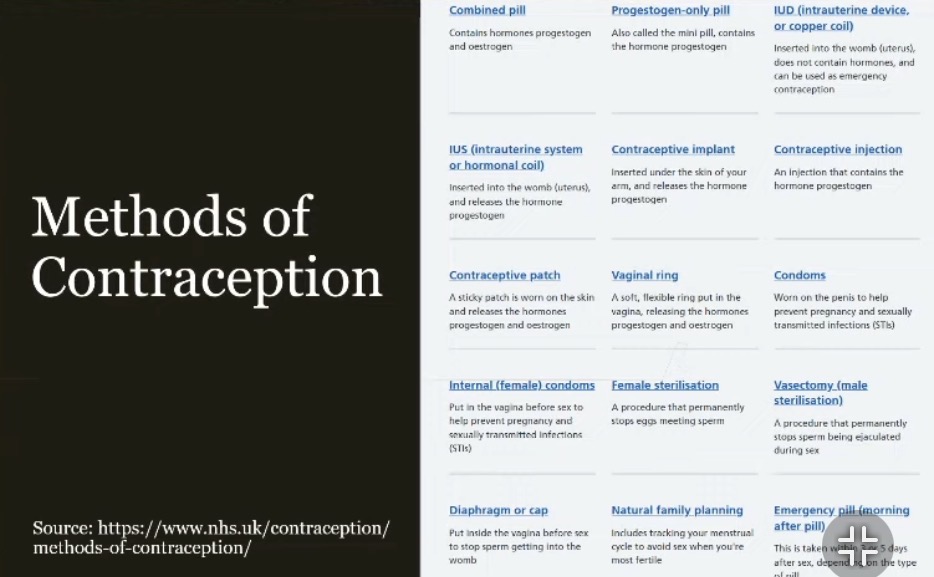
Why haven’t scientists developed a male version of the pill? Why do people tolerate women taking invasive treatments? A doctor wrote me, “Hormonal birth control is associated with higher risk of depression, with highest risk in adolescents. There is 50% relative increased risk” and it’s “associated with relative 2-3 fold increased risk of suicide attempt, again higher in adolescents”; and he provided me with the links to the National Library of Medicine. Wouldn’t it be better if husbands said to their wives, ‘I love you and don’t want you to take anything that may hurt your body’? One benefit of God’s teaching on sexuality is that it respects women’s bodies and is completely natural; but it does require self-control.
Most people don’t know that, in the U.S., as of 2023, 63% of abortions are through the abortion pill. In the following video, which isn’t graphic, we’ll see how this pill not only kills a person but has adverse effects for women, but notice the hope at the end.
St. John Paul II stated that contraception and abortion are fruits of the same tree (Evangelium Vitae, 13,3), because they have a mentality that doesn’t want to accept responsibility for children; they’re not gifts, but can be an obstacle to our happiness. For the culture of life, children bring incredible responsibilities and can completely overwhelm us, but, in general, the mentality is: If God gives us a child, we may not be ready, but we accept this gift.
In 1992, the U.S. Supreme Court said that people “for two decades… have organized intimate relationships… in reliance on the availability of abortion in the event that contraception should fail”. The mentality is that abortion is backup contraception.
This brings us to in vitro fertilization—we talked about this two years ago. One question we asked was:
Do parents have a right to a child? A right means we’re entitled to something and can demand it. We have the right to life and to free speech—we deserve it. But, do people have a right to a child? No. Because children are subjects, not objects. We can’t lay claim to another person. Slavery is wrong because a person possesses another.
For decades, contraception has taught us to think: I don’t want children. Abortion has taught us to think: If I’m not ready for a child, I terminate it—the child’s an object. Now, IVF says, if I want a child, I can make one. IVF specialists choose which embryos are fit to survive, which will be experimented on, or frozen. Couples can rank embryos based on genetic predictions of IQ, height, and health. So, some parents will choose between a Deacon Andrew embryo or me… when both should be welcomed. And many parents won’t accept an embryo with a serious defect, because they paid money for a healthy baby. The baby’s part of a transaction. The mentality of seeing babies as commodities is part of why there are fewer babies with Down Syndrome, fewer female babies in China and India, because they’re aborted.
Jesus says today, “Blessed are those who hunger… for righteousness, for they will be filled” (5:6). Here now is a video explaining our 40 Days for Life prayer vigil:
There are sign-up cards in the pews, so, if you’re able to fill them out today, that would be greatly appreciated! Thank you!
And please don’t forget, as mentioned, we’re going to show graphic photos of what abortion really is next week, so, if you don’t want to see it or you don’t want your children to see it, please have them close their eyes and look down, or go to another Mass elsewhere.
Let’s finish with another reversal of expectations. For years, people have said that, if abortion is illegal, women will seek back alley abortions, which is why they said 5,000 women died annually before abortion was made legal.
In 2021, however, when Texas outlawed abortion once a baby’s heartbeat was detected, abortions didn’t go up because pregnancy-resources centers stepped up to help women and the state gave $100 million in support. Call volume went up by 30% and the number of ultrasounds went up by 100%. Similarly, in Mexico, El Salvador, Chile, Poland, and Nicaragua, when laws stopped more abortions, the health of mothers improved (Ryan Anderson & DeSanctis, Tearing Us Apart, 79). And it should be known that the number of 5,000 back alley abortions was never true—even the Washington Post has admitted this. So, the culture of life is better for babies and for women.