According to anthropologist Dr. Gary Chapman, these are the five love languages: words of affirmation, physical touch, gifts, acts of service, and quality time. For some people, we can say we love them all day long (which may mean a lot to us), but, (Acts of Service) if we don’t help them at home, we’re in trouble! For others, we can buy them gifts and hug them (which we appreciate), but, (Quality Time) if we don’t spend time with them, they’ll feel neglected (which is really annoying because it takes so much time to love them). Can we do an informal survey? I’m going to ask which sign of love means most to you, and you put up your hand. Words of affirmation? Physical touch? Receiving gifts? Acts of service? Quality time?
Today, we’re pondering the signs God gives us: Some are obvious, other signs need to be learned.
In the First Reading, Isaiah prophesies, “On this mountain the Lord of hosts will make for all peoples a feast of rich food, a feast of well-aged wines, of rich food filled with marrow, of well-aged wines strained clear” (Isa 25:6). For the Jewish people in the ancient world, where food shortages and famines were common, food and wine were the symbols of God’s love. They were as powerful for them as Christmas is for us: When we see Christmas trees and lights, hear Christmas songs in stores, we think of God’s reaching out to us by becoming human.
But in this passage, Isaiah takes it a step further and foresees a promise: At some time in the future, “He will swallow up death forever. Then the Lord God will wipe away the tears from all faces, and the disgrace of the people he will take away” (Isa 25:8). This passage is a famous prediction of an age at the end of the world, when we no longer suffer, when God brings justice and redeems those who love Him—the sign of this future age is an abundance of food and wine.
Do we understand the signs God gives us? St. Augustine has a fascinating way of explaining the seven Sacraments. He starts with a definition of a sign: A sign is something which leads to knowledge of something else. Then there are two kinds of signs: natural and arbitrary. A natural sign is, e.g., smoke to fire, or Deacon Andrew to good-looking—there’s an obvious connection between the two. An arbitrary sign would be a flag to a country; there’s no obvious reason why a rectangular cloth represents a state.
In the case of the Sacraments, they’re all natural signs: Baptism involves washing with water which points to washing away sin. The Eucharist is a kind of food… that points us to spiritual nourishment.
But Augustine points out that every Sacrament needs God’s word to take the physical sign to the level of the spiritual. He says, in reference to Baptism, “Take away the word and what is water but water? [If we pour water over someone’s head without the words, ‘I baptize you in the name of the Father, and of the Son, and of the Holy Spirit,’ then there’s no Sacrament, just a pouring] The word is joined to the element [of water] and the result is a sacrament” (Tractate on the Gospel of John, 80, 3). So, when we understand God’s Sacraments, we understand His signs of love!
A few months ago, Vivian and her two daughters were baptized, and she was deeply touched by her new identity as a daughter of God.
A Protestant pastor wrote me a while back. She was raised Catholic but came to encounter Jesus in evangelical churches. She told me that she misses the rituals with which she was raised. So, she asked a spiritual friend if they could confess their sins to each other. She realizes the importance of confessing her sins, not just in her heart, but out loud. God willing, one day, she will realize that God has given us a tangible way, a Sacrament, to receive His forgiveness.
God loves us so much! There are signs of His love all around us! Many people look at the beauty of nature and see His goodness. Bishop Conley of Nebraska, during his clinical depression, saw a sign of God in the moon, which, though often invisible, is still there.
Sometimes we can ask God for signs, if it’s done out of love and not because of doubt. Fr. Anthony Nguyen, a monk at Westminster Abbey, when he was studying at UBC and discerning priesthood, asked St. Therese for a sign that he should enter the seminary, and, as happens to thousands of people, he kept on coming across roses in unexpected ways, such as people randomly giving him roses.
During the Vietnam war, Catholic pilot Captain Guy Gruters was shot down and captured. One time, during interrogation, he took a risk and gave witness to Jesus. He was punished by being thrown into a hot box: a metal box in the scorching sun that a prisoner is forced into—a terrible form of torture. However, the guard putting him in took pity on him and gave him a piece of cardboard and motioned to fan himself. As soon as he went in, a storm came over and cooled the box off. Captain Gruters saw these as signs that God hadn’t abandoned him, and he thanked Jesus and Mary over and over while in the box .
As we become more sensitive to God’s signs of love, we should be mindful of showing our love for Him with signs. As mentioned last Sunday, on Oct. 17, 2026 and Oct. 24, 2026 we have an obligation to vote for the candidates whom we think best align with the principles of our Catholic faith.
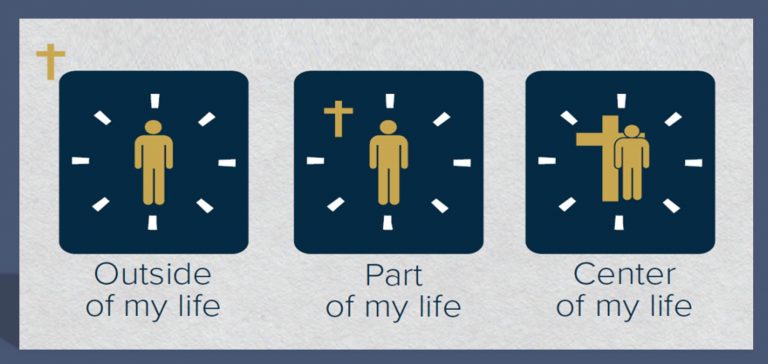
Also, in six weeks, we’re going to have our sixth annual Christ the King Challenge, where, based on the Relationship Diagram of CCO, we ask ourselves if we’ve made a decision to place Jesus at the center of our lives. Putting up our hands is a sign of our decision and commitment.
Today, on this Thanksgiving weekend, we’re mindful that we don’t deserve God’s love and help, and that we have so many blessings.
Can we see the signs of love God the Father is giving us? What sign can we give Him in return?