

I once suggested to a young Catholic woman to be mindful of her anger. I had known her for a few years, we had conversations, so I asked if I could share an observation, noting that I might be wrong. I told her I often saw a severity in her face and that, if she’s struggling with anger, she should try to resist it because it would affect her relationship with God. She took it very well, but, from what I know, she stayed distant from Him.
Please know that, when I make observations about anger, I do it from experience: I could be very angry as a child. If someone hurt me, I couldn’t let it go. If I was wrong, I wouldn’t admit it. Sometimes I wanted to stay angry even when people tried talking sense into me. Even now, I can be tempted to stay frustrated. All this distances me from God.
The context for today’s Gospel is that Jesus had been rejected by many people. He had gone to the towns of Chorazin, Bethsaida, and Capernaum, done many healings and miracles for the people, but they ignored His love. The text says, “He began to reproach the cities in which most of his deeds of power had been done, because they did not repent” (Mt 11:20). But then He shifts focus to people who have responded, “At that time Jesus said, ‘I thank you, Father… because you have hidden these things from the wise and the intelligent and have revealed them to infants; yes, Father, for such was your gracious will’” (11:25). He’s thankful to the Father because some do love Him in return, that is, those who trust Him, like children do their parents.
Why does God the Father hide things from ‘the wise and the intelligent,’ that is, proud people? One reason is so that we’re sincere about trying to know Him. One of my philosophy professors, when he knew that we didn’t study, wouldn’t answer our questions, because He wanted us to be sincere about really learning.
Let me tell you a funny story. When I was in Rome, I had to postpone an exam from July to September because I got sick. During summer break, I never studied. I actually started studying on the flight back, with the exam the next day. The professor gave 20 questions to prepare, and it was a 10-minute oral exam where you choose one question and he chooses the other—it’s like gambling! So, here was my strategy: When I entered, he asked what question I chose and I chose my second strongest question, number 12, hoping that that would push him to choose from another group of questions where number five was my strongest. When I finished my question, he said, ‘Allora, facciamo numero cinque,’ which means, ‘Let’s do number five.’ I remember nothing about that course because I wasn’t sincere about truly knowing the material. In the same way, God will hide spiritual things from us if we’re not sincere about knowing Him.
Yet, there’s a deeper reason. When we’re proud, it’s hard to know God because He’s humble. It’s like meeting someone who’s always cheerful and we think, ‘I don’t get that guy.’ This brings us back to anger. If we’re unjustly angry, resentful about parts of our life, it’s hard to know God because we’re so different from Him. He’s hidden from us. He wants us to know Him because He’s our Father, but we block Him.
Jesus continues, “No one knows the Son [Jesus] except the Father, and no one knows the Father except the Son and anyone to whom the Son chooses to reveal him” (11:27). God the Father and Jesus are one though distinct; only They know each other fully. For us to know God the Father means we have to be brothers and sisters of Jesus—we go through Him. When He says ‘chooses to reveal,’ He doesn’t mean He chooses some and not others. What He means is that knowing the Father is a gift; we can’t say, ‘I deserve it.’ All we can do is ask for the gift the way spiritual children do.
I once asked a parishioner here named James Chau if I had seen anger on his face years ago, but this time, I was incorrect. It wasn’t anger; he was going through a difficult time in his career and that led to his serious demeanor. He would come to Mass, thinking only about where to eat after. He told me, ‘I was in the second diagram’: Jesus was part of His life but not the center.
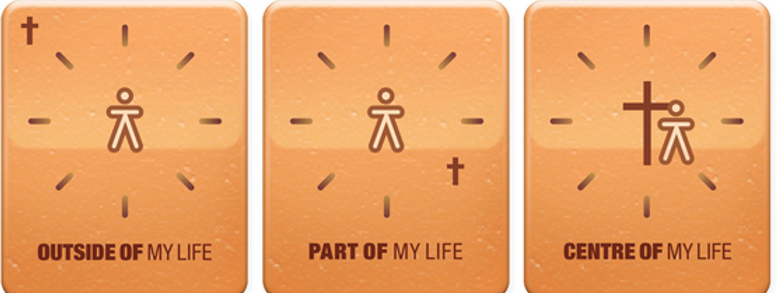
But then God got his attention and he responded: He signed up for Faith Studies, and, God willing, he’s going to be ordained deacon in two years. His serious demeanor has also become a regularly joyful face.
This leads us to Jesus’ promise: “Come to me, all you that are weary and are carrying heavy burdens, and I will give you rest. Take my yoke upon you, and learn from me; for I am gentle and humble in heart, and you will find rest for your souls. For my yoke is easy, and my burden is light” (11:28-30). To know God as our Father, Who takes care of us, Who draws good out of evil, is true rest. Jesus is not promising that life will get easier when we follow Him. Let’s be clear: Everyone suffers and Jesus suffered. If we ask Him to be at the center of our lives, life may get harder, but it will be better. E.g. We’ll have to let go of our unjust anger and forgive people—that’s hard at first but better, because, when we don’t forgive, we hurt ourselves. It’ll mean we have to admit when we’re wrong but being proud is tiring; confessing our sins is liberating. Staying frustrated is a heavy yoke. I need to put it down and take up Jesus’ yoke.
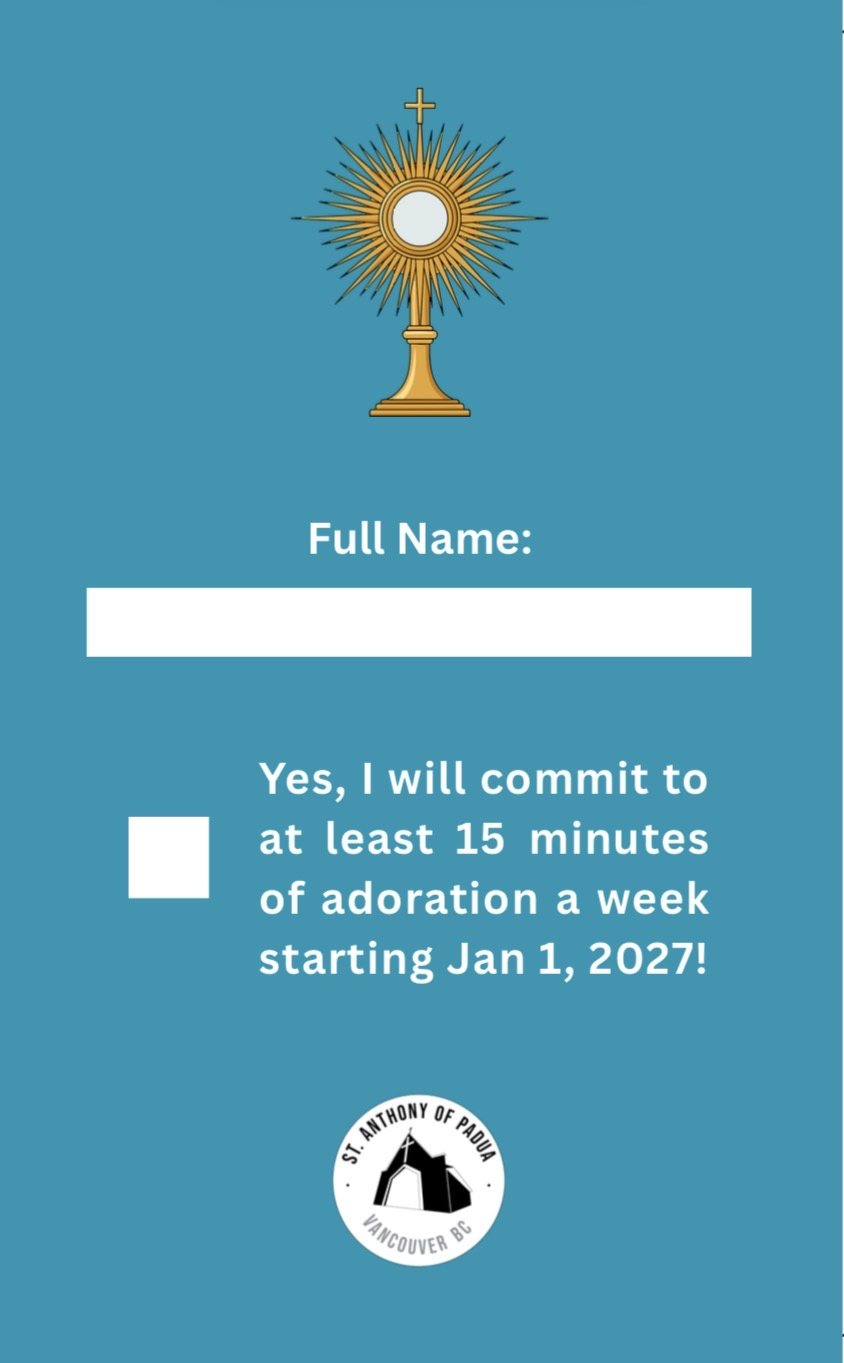
Today, we are doing our midyear adoration poll. If you’d like, you can pull out these cards and answer the question, ‘Yes, I will commit to at least 15 minutes of adoration every week starting Jan 1.’ If your answer is yes, please check the box, write your name, and put the card in the collection basket. Thank you!
All of us carry some yoke. We get to choose. Committing to adoration for life is an easy yoke: sometimes it will be hard to keep it, but it always gives rest for our souls. So, either we carry a yoke of anger, resentment, and pride, which blocks God, or we carry Jesus’ yoke of sincerity and humility, which leads us to know the Father.