

Two Sundays ago, we mentioned Debbie Harding, who suffered from cancer at the age of 38. I didn’t mention that she also had two miscarriages and her husband was struggling with addiction. The turning point was when a cancer survivor told her about actually wanting to die. This pushed her to face her deepest fear, that she would die and leave her three young children alone. That was when she let go, allowed God to take control and trusted in His plan: “After that day there were no more tears. I decided that cancer… might take my life, if that is what God wanted, but it was not going to pounce upon my soul… In my agony I became spiritually strong. ‘Come on, Deb… You can do it. Just focus on the cross, focus on the cross, focus on the cross” (Jeff Cavins & Matthew Pinto, Amazing Grace for Those Who Suffer, 200), meaning Jesus’ Cross.
When we’re suffering, we pray to Jesus and can draw from His strength and love while He was on the Cross. One of my deepest consolations is that, when I suffer, Jesus can shine through me. Through my Baptism, I’m united to Him. If I do His will, that is, love, persevere, and smile, then His love while on the Cross can shine to others now.
Today’s Gospel says, “From that time on, Jesus began to show his disciples that he must go to Jerusalem and undergo great suffering… and be killed, and on the third day be raised” (Mt 16:21). When Jesus healed people , let’s realize that those healings did not save them; it saved them physically, the purpose of which was to lead them to faith (which is why they’re important), but Jesus’ greatest act of love wasn’t physically healing people. What saves people is His ‘great suffering,’ when He took our sins upon Himself and suffered the punishment for them; when He allowed Himself to be ‘killed’ in obedience to God’s plan, which overcame our disobedience; and then was ‘raised’ to offer us His eternal life. So, what saves us isn’t being healthy, which is good, of course. What restores our relationship is faith, trust, and love, and these virtues are often strongest when we’re pushed to our limit.
St. Peter loves Jesus, and therefore tells Him that this should never happen; he doesn’t want his friend and his God to suffer. But Jesus rebukes Peter, “You are thinking not as God does, but as humans do” (16:23). God is always thinking about love and bringing us home, even if it means dying for us. We tend to think about our comfort, even if it means pushing God away and being selfish.
This is what’s called the Hill of Crosses in Lithuania:

It’s believed to have started in 1831. During the occupation by the Soviets between 1944 and 1990, the socialist rulers persecuted Christians and bulldozed the Hill three times. They didn’t want people going to Jesus’ Cross, because that’s where their faith and strength came from. But the people would come during the night and rebuild the hill, risking harsh punishment.
Jesus says, “If anyone wants to become my follower, let him deny himself and take up his cross and follow me” (16:24). To follow Jesus means crucifixion. First, because we die to our sinfulness. For example, when we were young, did our parents ever tell us to apologize to someone? We would say, ‘Sorry,’ but not look at the person in the eye. What was happening? Our pride was dying. To follow Jesus means our lust, laziness, greed, vanity, etc. must die. Because we’re naturally selfish, spending time helping others and losing time for ourselves sometimes feels like agony.
Second, love involves sacrifice. Think about the happiest moments of life. Weddings are beautiful, but people put in months of work. Every Sunday, we come to Mass to receive Jesus peacefully after a difficult week. But who has to work hard to make it happen? Who could it be? To have a beautiful Mass requires the choir, sacristans, hospitality, ushers, tech team, lectors, servers, gift bearers, and flower team to sacrifice. Yet, over time, love can make it a joyful sacrifice.
This is the reflection that most sustained Debbie Harding: “The everlasting God has, in His wisdom, foreseen from eternity the cross that He now presents to you [Our crosses aren’t meant to hurt us, but bring us closer to Jesus on His Cross and perfect us in love. Now, it doesn’t mean we give up when suffering. If people are hurting you, defend yourself; if you’re sick, take care of yourself, because that’s part of love! However, God allows the current pain so that we share in Jesus’ love and overcoming of sin]… This cross He now sends you He has considered with His all-knowing eyes, understood with His divine mind, tested with His wise justice… and weighed with His own hands, to see that it be not one inch too large and not one ounce too heavy for you. He has… taken one last glance at you and your courage, and then sent it to you from heaven” (201).
This reflection is similar to a famous modern parable: Someone complains to Jesus that their cross is too heavy. So, Jesus takes them into a room full of crosses to choose a new one. The person says, ‘That one’s too heavy. That one’s too light, it won’t help me grow. I’ll take that one.’ And Jesus says, ‘That’s the one I gave you!’
Here now is the testimony of someone whose following of Jesus involves more crosses than typical.
Let’s ask for the Holy Spirit’s help, because we can’t come to Jesus by our own power. We need help to pray, ‘Jesus, I trust in You, I love You.’ And try to sign up for one of the spiritual programs coming up, in order to grow in faith.
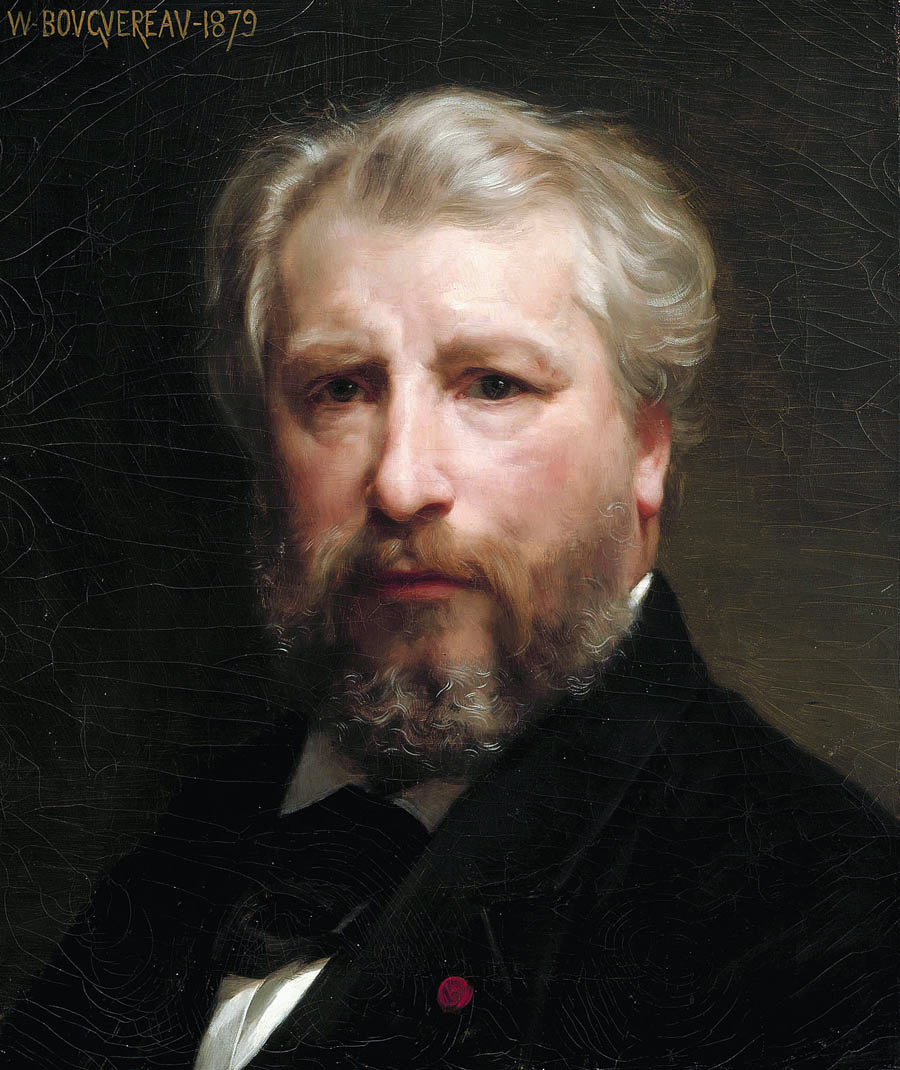
William Bouguereau (self portrait)
William Bouguereau is a famous French religious painter. Eight years before his death, having suffered much in life, including the death of his wife and three of his children, he created this work The Compassion:
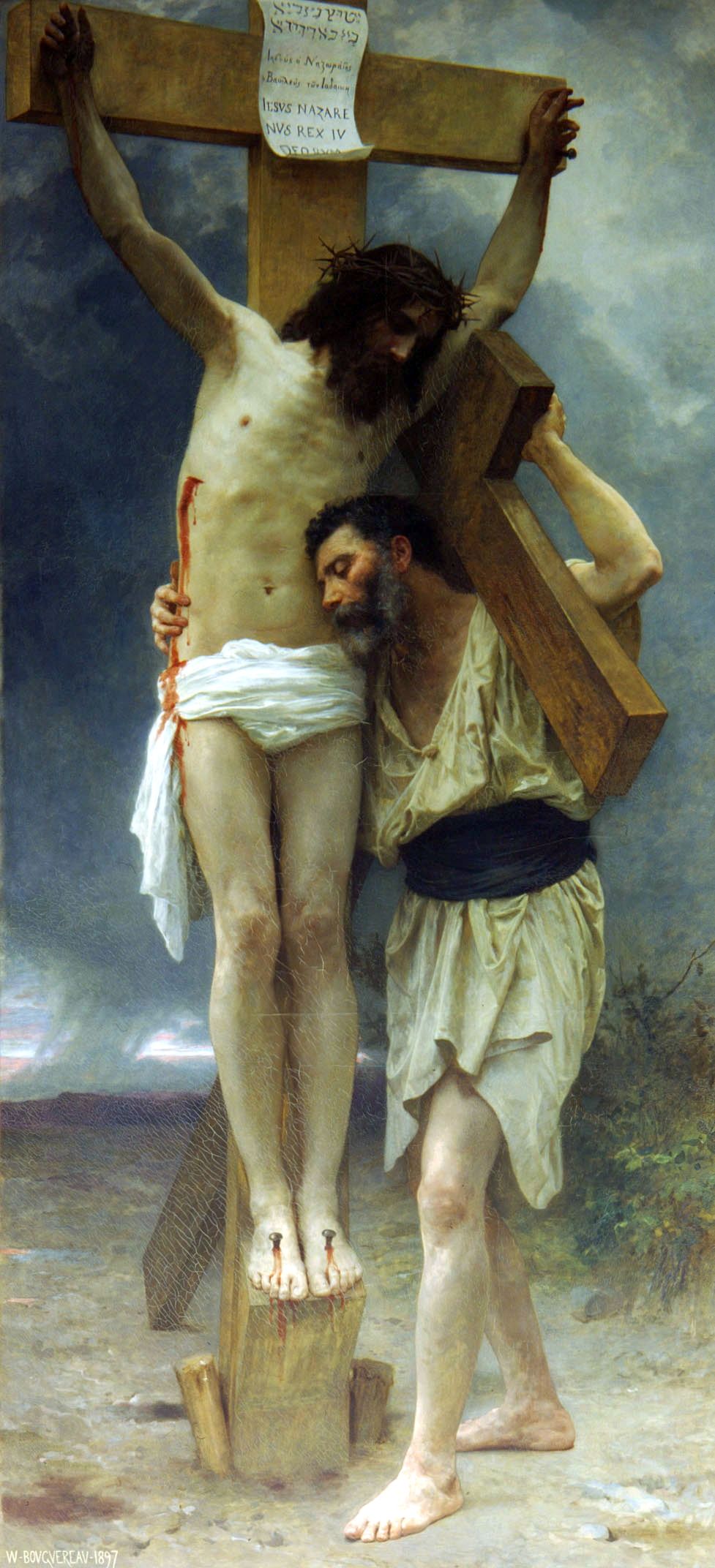
One art historian says that the man with his head on Jesus’ side represents humanity, who, carrying our own crosses, goes to Jesus and finds redemption. He shows compassion for Jesus, because Jesus first had compassion on us—their heads are in the same position, leaning towards the other. Jesus’ blood drips down upon the man’s hand, symbolizing how Jesus’ sacrifice was for us. Finally, though Jesus died on the hill of Calvary, Bouguereau shows Jesus dying on a barren wasteland, representing life before finding Jesus. Bouguereau never sold this painting but kept it in his studio.
Jesus is reaching out to us now! We can make it through the current suffering. We just go to Him and focus on His Cross.