For the first time, I’m actually not nervous about today’s Christ the King Challenge, our sixth year doing it, but excited! I’ll tell you why in a minute. For anyone visiting, you don’t have to answer any of the following questions unless you want to. Jesus loves us so much that He died and rose for us. The Relationship Diagram helps us to understand our response: if Jesus is outside of our life, a part of it, or the center.
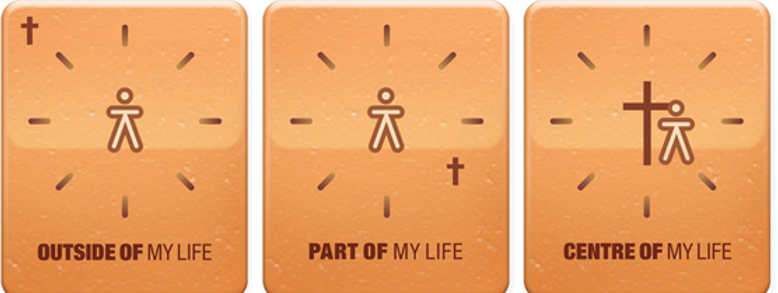
We’re asking three questions: Have we made the decision to place Jesus at the center of our lives? Have we done so for the first time in the past 12 months? (I made my decision years ago, so I wouldn’t put my hand up.) Finally, if Jesus isn’t at the center, would you like Him to be? Are you ready? Please put up your hand (and it has to be high) if you’ve made the decision to place Jesus at the center of your life. Please put up your hand if you’ve made this decision for the first time in the past 12 months. If He isn’t at the center, please put up your hand if you would like Him to be.
I’m excited today because some decisions help us see things in a new way. This is one of our stained glass windows:
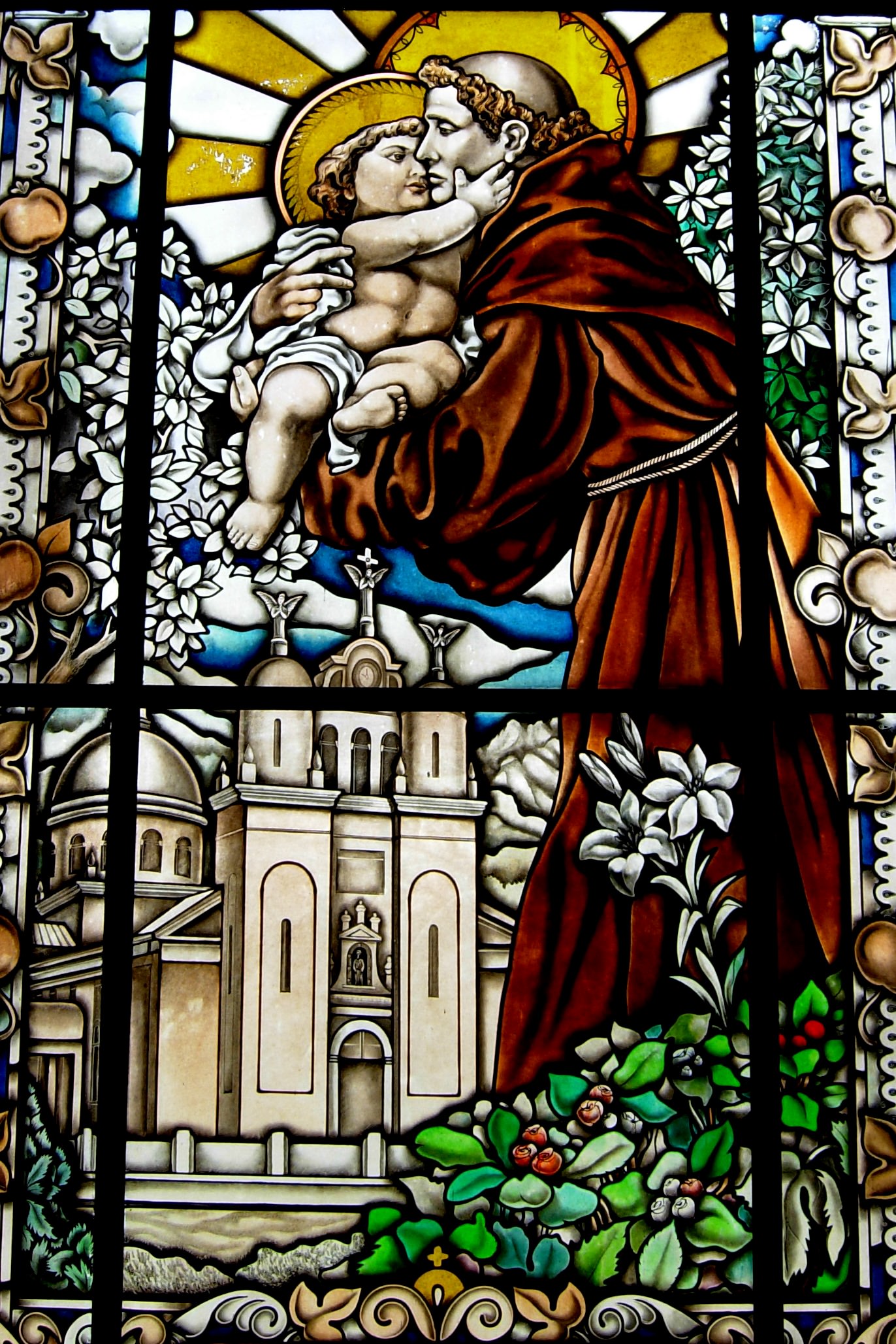
St. Fulton Sheen used this analogy regarding faith. When we don’t have faith, we’re on the outside, and the window appears to be mere metal, wire, and glass. But God offers the gift of faith, and, when we decide to accept it and trust in His goodness, then we move to the inside, and the window lights up.
Whenever we respond to God’s love even in small ways, like trying to pray for the first time, coming to Mass in faith, we see things more clearly!
Jesus’ teaching today is now referred to as the Parable of the Sheep and the Goats, about God’s judgment of us at the moment of death: “When the Son of Man [Jesus] comes in his glory… then he will sit on the throne… All the nations will be gathered before him, and he will separate people one from another as a shepherd separates the sheep from the goats” (Mt 25:31-32). Jesus will judge not only Christians but ‘all the nations’ because we all have a conscience. Even before I knew Jesus’ teachings, I remember feeling badly about making fun of other kids. Have you ever made someone cry? What about walking by someone on the street without helping when we knew we could? And, if we knew this was wrong, did we turn to God for forgiveness?
“The king will say… ‘Come… inherit the kingdom prepared for you… [indicating heaven] for I was hungry and you gave me food… I was a stranger and you welcomed me… I was sick and you took care of me…’ Then the righteous will answer him, ‘Lord, when was it that we saw you hungry and gave you food…? And the king will answer them, ‘Truly I tell you, just as you did it to one of the least of these brothers and sisters of mine, you did it to me’” (Mt 25:34-37,40). How we treat people is how we treat Jesus. The reason St. Teresa of Kolkata was celebrated by all is because she did what we know we have a moral obligation to do: help others in need.
So, why do we struggle to help people? There are various reasons, such as sin, but also our view of happiness. Philosophers distinguish four levels: Immediate Gratification (Physical); Achievement; Contributive; Transcendent. It’s good to know that, when immediate gratification is the happiness we enjoy most, it’s hard to make sacrifices to help others. E.g., most children live to have fun. When we ask them to do chores, help weaker children, spend time with grandma, it’s hard for them; there’s nothing in it for them—this was my life before Jesus. Fast forward to adulthood, we may still see life as mainly about having fun. We study and work because we get something out of it. But we don’t volunteer that much. We might say that we don’t have enough time, but the deeper reason, which we don’t think about consciously, is that it doesn’t make us happy. We want to enjoy life, and life is about what makes me happy (which is being with people I like, doing fun things, going on trips, etc.).
However, many of us realize that there’s a better kind of happiness: being good at sports, sacrificing parties to get good grades or a good job, working hard hours to make money! But, again, the focus isn’t on helping others. We might do so through our job, but that’s not the goal. The goal is to succeed at things that make us happy.
And when God calls us to focus on helping people, a part of us wants to, but it’s very difficult; and, when we don’t help people that we should help, it can lead to sins of omission. Jesus says, “Then he [the King] will say to those on his left, ‘Depart from me, you cursed, into the eternal fire prepared for the devil and his angels. For I was hungry and you gave me no food… I was a stranger and you did not welcome me… sick… and you did not visit me.’ Then they also will answer… ‘Lord, when did we see you hungry…?’ Then he will answer them… ‘Truly, I say to you, as you did not do it to one of the least of these, you did not do it to me’” (25:41-45).
Here’s the good news: The Holy Spirit loves us and works in our hearts: Deep down we do want others to be happy. And when we make Jesus the center of our lives, we see things in a fundamentally different way: Our focus shifts from our success to helping others, using our money and time to care for them. And over time, we care about everyone.
And, if Jesus is my greatest happiness, I see Him in others. I want to love Him, starting by loving my family. Our prayers become less about us and more about others and God. We may even start thinking: Is God calling me to dedicate my whole life to Him? Is He calling me to be a priest or sister, not to get married, so that others can find eternal life?
Whether or not we’ve placed Jesus at the center of our lives, could we today listen to His call to help the poor, the needy, and the sick? Is there one person in our life who comes to mind that we could help more? To love that person is part of loving God.
This is Bl. Dina Belanger, born in 1897 in Quebec City. She loved God from an early age, but, like many of us, found the homilies boring and, at home, she could throw tantrums.  Later, she wrote in her autobiography about how her parents focused on God and others, “All my life I have had… the example of parents who generously relieved the poor, giving alms on every side… How often have I heard them say, ‘Do not put down my name,’ or ‘This is for you, but do not say anything about it.’ … Nursing the sick was a real mission for my mother, a task which my father shared by approving and assisting… This conduct on his part often entailed heroic sacrifice. How many outings forfeited? How many plans sacrificed to relieve some needy family, either among our relatives, or total strangers?”
In response to the gift of having holy parents, she wrote, “To prove my gratitude, I am duty bound to become a saint… Only thus can I make a fit return for their past and present solicitude. Yes, I will become a saint. I will become holy in the degree God has marked out for me. Thus may I repay them for the pains they have taken for my education, and console them in their grief over our separation” when she left home at 24 to become a religious of Jesus and Mary.
Today is exciting because Jesus is calling us to love others the way He does. A simple decision of trust or obedience can move us from the outside to the inside, and to a deeper happiness.
And now, if you’re able to fill out the cards and put them into the basket when it comes around, that would be appreciated. Thank you!