Many of us know the famous Litany of Humility, popularized in the 20th century, and probably all of us are challenged by its petitions: “From the desire of being esteemed, Deliver me, Jesus… From the desire of being approved, Deliver me, Jesus… That others may be loved more than I, Jesus, grant me the grace to desire it… That, in the opinion of the world, others may increase and I may decrease, Jesus, grant me the grace to desire it… That others may be praised and I unnoticed, Jesus, grant me the grace to desire it.”
Today is our third and final homily in our series on the internet. Because of our pride, when we use social media, it hurts when people don’t reply to or ‘like’ our posts, when we see people have better vacations, when Fr. Richard Conlin gets more views than I do. Life online teaches us to worship ourselves, and so we’re envious when others do well.
Today’s Gospel is what’s now called the Parable of the Vineyard, and we’re going to focus on the reality that God wants to bless all of us, but we’re envious about others’ blessings: “The kingdom of heaven is like a landowner [God] who went out early in the morning to hire labourers for his vineyard [the Jewish people who received His call thousands of years ago]. After agreeing with the labourers for the usual daily wage, he sent them into his vineyard. When he went out about nine o’clock, he saw others standing idle in the marketplace; and he said to them, ‘You also go into the vineyard, and I will pay you whatever is right.’ So they went” (Mt 20:1-4). He then invites more labourers at 12, 3, and 5 p.m., who represent non-Jewish people like us.
“When evening came, the owner… said to his manager, ‘Call the labourers and give them their pay…’ When those hired about five o’clock came, each of them received the usual daily wage [What is the daily wage? Being in a relationship of love with God, that is, eternal life, heaven, salvation]. Now when the first came, they thought they would receive more; but each of them also received the usual daily wage. And when they received it, they grumbled against the landowner, saying, ‘These last worked only one hour, and you have made them equal to us who have borne the burden of the day and the scorching heat’” (8-12). This is a good objection: Is it fair that people who commit many sins may eventually receive the same gift as someone who’s been faithful to God since they were young? No. But, it’s generous. God loves us all that He offers eternal life until the moment of death to great sinners like us who believe in Him, repent, and receive the Sacraments. God says, “Am I not allowed to do what I choose with what belongs to me? Or are you envious because I am generous?” (20:15).
Envy means sadness at someone else’s good fortune. We’re not talking about healthy comparison, which inspires us to be better. We’re talking about the comparison game, where, for us to win, others must not do as well; when others do well, we lose. Social media encourages the comparison game. The U.S. National Library of Medicine lists a number of studies on social media and their key findings:
1) “Individuals who spent more time on Facebook each week and individuals who had large Facebook networks… were more likely to believe that others had better lives than they had, view life as less fair, and think others were happier than they were.”
2) “Individuals who looked at online profiles of more attractive and more successful individuals [Deacon Andrew] tended to feel less attractive and less successful.”
3) “Viewing selfies is associated with lower self-esteem.”
4) “Higher… Facebook use is associated with greater depressive symptoms and lower life satisfaction through greater feelings of envy.”
Dr. Jonathan Haidt gives four reasons why girls are harmed more by social media than boys, and one is that girls are more affected by visual social comparison and perfectionism (154). A young woman’s “social standing is usually more closely tied to her beauty and sex appeal… When girls go onto social media, they are subjected to more severe and constant judgements… and they’re confronted with beauty standards that are further out of reach” (154). Here’s a graph measuring U.S. students in high school who were satisfied with themselves; around 2010, there was a sudden decrease:
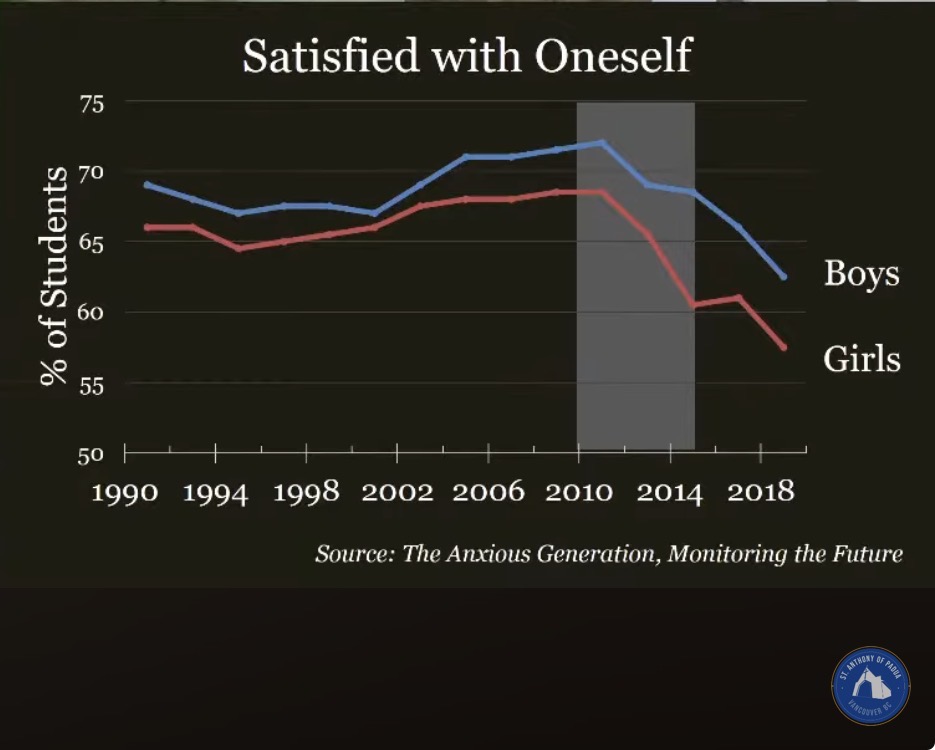
This correlates with 2009, when Facebook introduced the ‘Like’ button and Twitter introduced the ‘Retweet’ button, and, in 2010, front-facing cameras made it easier to take pictures of… ourselves. These changes helped shift social media platforms from communicating with people we know to communicating with huge groups “in search of validation… from strangers” (Jonathan Haidt, The Anxious Generation, 118). Life online tempts us to present a false appearance of ourselves, using filters or photos that aren’t quite realistic. Sometimes we meet someone and think, ‘Whoa, he/she doesn’t look like their photo online.’
What’s the solution to envy? Jesus’ generosity. He’s so generous that He becomes human, enters into our lives, takes on our pains and sins, and dies for us. Envy and generosity can’t coexist. If we’re envious of what others have and their talents, it may be a sign that we don’t want others to have more blessings. On the other hand, if we hope that others have more talents and blessings, would we be envious?
The goal of this series hasn’t just been to delete apps or reduce time online, though that helps. The goal is to share in Jesus’ life, forgiveness, and generosity, which then affects how we go online.
Jesus is challenging us, so let me repeat what I said two weeks ago: I’ve been too soft on this issue. So, with love, I again warn you that I think you’re overestimating yourselves spiritually, and you need to make spiritual improvements.
Give God more time in daily prayer. He typically gets the leftovers; we squeeze Him in when doing other stuff. Many say they talk to God throughout the day, which is good, but not generous. By Jan. 1, 2027 we’re inviting people to go to adoration once a week, because, for most people, that’s generous. When we offer Faith Studies or Faith Formation, it’s not to make the leaders’ lives better; it’s a concrete way to give time to God. Typically, human nature says: ‘I’ll pray and read at home, when I’m free,’ but that’s within our comfort zone and isn’t generous.
When we wake up, pray first before looking at your phone. Never go to your phone first until you pray, unless there’s a serious reason. When you go to bed, generally, leave the phone outside your bedroom. Try praying before going online. From now on, if anyone asks me or Deacon for a blessing, they have to bless someone else after. Don’t just ask God for blessings; bless others! Lastly, at home, please ask each other, ‘Is there anything I can do?’ When we get home, or enter the kitchen, or before and after dinner, we ask, ‘Is there anything I can do?’; I’d like to suggest gently to anyone who generally leaves quickly after Mass: At some point, ask someone on hospitality, ‘Is there anything I can do?’
Today also is an opportunity to sign up for the Sanctuary Course, which is a way of walking with our loved ones who struggle with mental illness.
Life online is about ourselves, getting what we want. Life with Jesus is about worshipping God, being happy that others are doing well, that they may even have more than we do! The Litany of Humility ends with, “That others may become holier than I, provided that I may become as holy as I should, Jesus, grant me the grace to desire it.”