A few weeks ago, I contacted my Member of Parliament asking him to support Bill C-218, which prevents people being euthanized simply because they suffer from mental illness. It wasn’t hard, but it was outside of my comfort zone. To be honest, if people had not recommended I do it, I would have avoided it.
We probably all do this in some way: When we have an exam to study for, we’re suddenly willing to take out the garbage; when there’s a difficult email to write, we answer the easy ones first until we run out of time.
The Gospel and the First Reading today are linked, and their main point is that God wants spiritual fruit, meaning: ‘Don’t just tell Me you love Me, show Me.’ The First Reading begins with the prophet Isaiah speaking, “Let me sing for my beloved my love song concerning his vineyard” (Isa 5:1). God is the beloved, the Jewish people are His vineyard, and He does many beautiful things for them: “My beloved had a vineyard on a very fertile hill. He dug it and cleared it of stones, and planted it with choice vines… He expected it to yield grapes, but it yielded wild grapes” (5:2). Later in this oracle, we learn that ‘grapes’ refers to ‘justice’ and ‘righteousness,’ whereas ‘wild grapes’ refers to ‘bloodshed.’ God expected His people to do what is right but they engaged in murder, corruption, drunkenness, and lying, driven by their pride.
Let’s go back to an idea we’ve discussed a number of times: Ask any parent: ‘Why do you love your children: because of their grades, how they act?’ ‘No, I love them because they’re my children.’ ‘Does that mean you don’t care how they act?’ ‘No, I do care, but that’s not why I love them.’ God doesn’t love us because we keep His commandments but because we’re His children. Nevertheless, He still cares how we act.
Because parents care about actions, it’s possible that children can act in such a way that forces them to leave the house. If they repeatedly swear at their parents and don’t improve, repeatedly steal from their parents, do drugs in the house—these could be grounds for them to leave. Can they come back? Yes! Do their parents still love them? Yes! God will always love us, but we can break our relationship with Him by what we do.
Jesus says at the end of His parable, “Therefore I tell you, the kingdom of God will be taken away from you and given to a people that produces the fruits of the kingdom” (Mt 21:43). He directs these words at the Jewish leaders: They say they love God but don’t love Jesus; they say they love God but will eventually kill Jesus. When we pray over this passage, we want to apply it to ourselves: Would Jesus take away the Kingdom from me and give it to someone else because I’m not producing spiritual fruit?
It’s too easy for me to say, ‘I’m a priest. Jesus would never take the kingdom away from me.’ But then I don’t seriously try to be holy, because the minimum is enough. It’s an excuse for us to say, ‘I’m a good person. Jesus would never take the kingdom from me.’ Yet, are we producing fruit? One question we all ask is: How much time do I have to spend every day praying? It’s a good question because it lets us know the standard. But it’s a minimalist question. More fruitful questions are: How can I give more time to Jesus? How can I make sacrifices for Jesus to show Him I love Him? Another typical question is: How far can I go with my boyfriend/girlfriend? More fruitful questions are: How can I lead him/her closer to God? How can I prove my love for God by my affection for him/her?
I didn’t want to write this homily because I personally like to focus on spiritual things, but, with the general municipal elections coming up in two weeks on Oct. 17, 2026 then the provincial election the following Saturday, Oct. 24, 2026 I felt an obligation to bring up our civic responsibilities.
Those of us who have been here for a few years know that it’s a moral obligation for Catholics to vote: “Co-responsibility for the common good make it morally obligatory to pay taxes, to exercise the right to vote, and to defend one’s country” (CCC 2239-2240). But the Church doesn’t say vote for whomever we feel like. The Catechism says, “Conscience must be informed and moral judgment enlightened” (1783). We have a duty to find out: What do the Bible and Church teach about social issues? The Church will never tell us exactly for whom to vote, but she will give the principles of right and wrong.
For example: Most Catholics know that the right to life is the fundamental right because the rights to food, housing, and education aren’t useful if you’re dead. Many of us may not know that our province plays a role in abortion and MAiD. On May 7, 2026 our province announced changes to “make it easier for people to access… abortion services closer to home.” It boasts that “there are only two other provinces in Canada, Quebec and Saskatchewan, where midwives have the authority to independently manage and prescribe Mifegymiso for medical abortion”. Another example: Safe Injection sites. The Canadian bishops wrote that “they… do not address the deeper problem of addiction, nor do they bode well for public safety” and quoting Pope Francis, “The problem of drug use is not solved with drugs”. This contradicts Homer Simpson’s toast: ‘To alcohol! The cause of, and solution to, all of life’s problems! Yea!’
Here’s the resource we shared two years ago during the last provincial election. It breaks down the policies of each party so that we can inform our consciences and select who we think are the best candidates. The B.C. Election guide, I’m told, will be out soon.
In the meantime, here are some questions about other issues that we ask concerning candidates: How do they understand parental responsibility? The Church always defends parents’ rights so that the state doesn’t teach against the parents’ wishes, e.g. on sexual issues. What does the party want schools to teach about sex, gender, marriage? Can Christians act according to conscience in schools, medicine, employment, and public life?
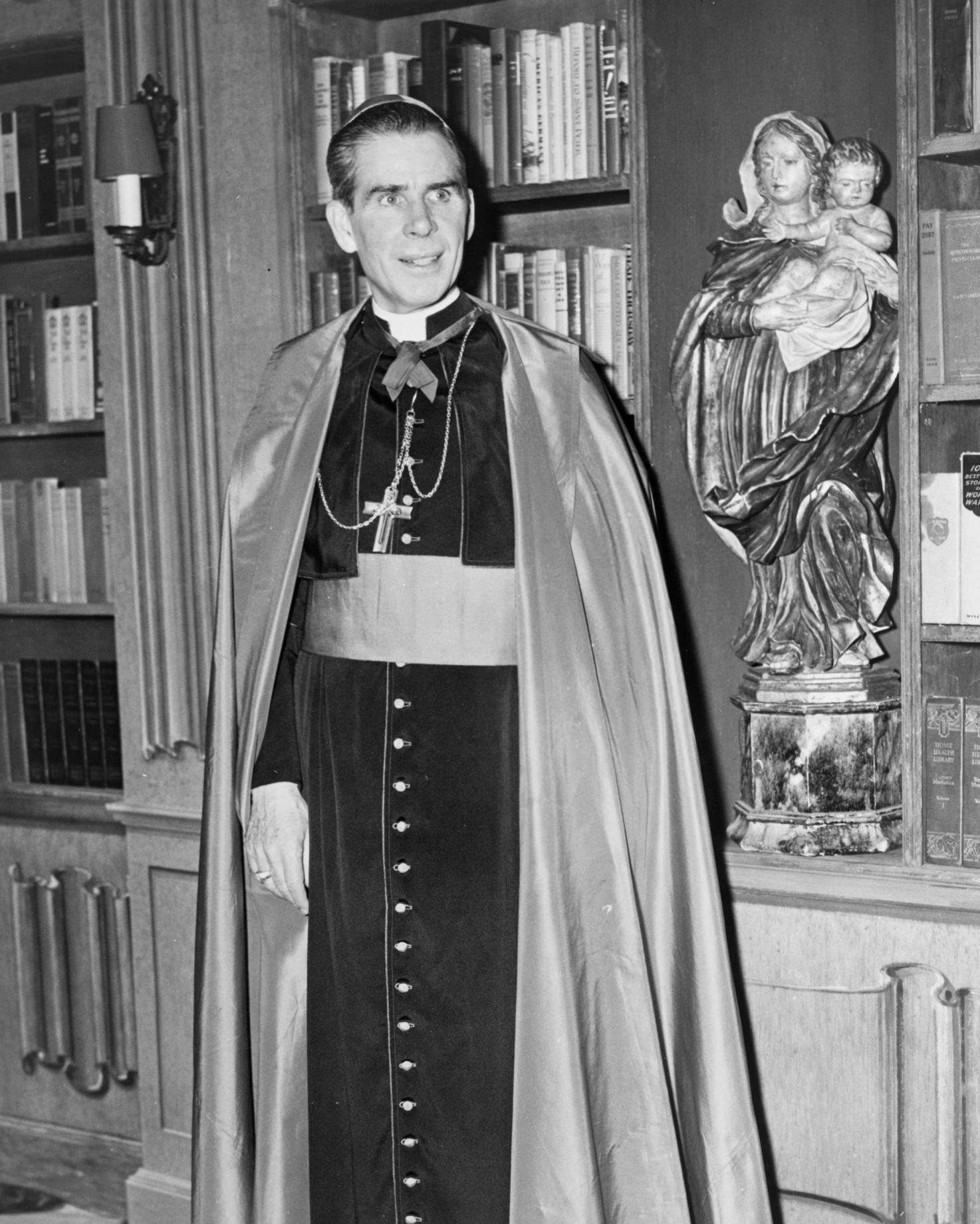
Blessed Fulton J. Sheen
Years ago, one thing that surprised me about Bl. Fulton Sheen was how often he preached strongly against communism. I thought it was good to try to take care of everyone and make things fair. However, based on Church teaching, I learned that a socialist government makes things unfair, for instance, by controlling the means of production and taking some people’s hard-earned wealth and giving it to people who haven’t earned it. He was preaching so strongly about political principles that the FBI opened a case on him, which is on their website today. Agents monitoring his activity came up with useless facts: he liked chocolate ice cream, woke up early, did a holy hour every morning, and once talked a police officer out of a speeding ticket. The point is that he did what was right, despite it being unpopular. In today’s passage of Isaiah , God reproaches “you who call evil good and good evil” (5:20). We must know what is good and evil according to what God says, not man. In the next three weeks, we have two small but important opportunities to show our love for Him.