
When I was 19, some friends told me about a guy at UBC who was doing his MD and PhD at the same time. When I heard that, I was envious: ‘How does someone do that?’ Sometime later, this man and I actually played hockey together and, when I saw that he wasn’t a good skater, I felt joy. He was so slow! And I thanked Jesus.
The breakthrough for me came a few years later. In the seminary, I was envious that a guy—noticeably shorter than I—was just as fast a runner and better at every sport; another guy memorized Latin prayers in half the time I took; and another was Mr. Popularity whereas I wasn’t. I brought this to Jesus in prayer. He helped me realize that I had my own gift: ‘I’m not the best in anything, but my role is to try to be as kind as Jesus.’ Peace came over me. In the past, I would have felt like I was lowering my standards to feel better, but, with Jesus’ point of view, I realized I had a small but unique way to love others.
St. Paul says today, “Now there are varieties of gifts, but the same Spirit; and there are varieties of services, but the same Lord; and there are varieties of activities, but it is the same God who activates all of them in everyone. To each is given the manifestation of the Spirit for the common good” (1 Cor 12:4-7). Paul is writing to new Christians in Corinth—one of their problems was envy, people breaking into factions because each wants to be the best, which is a natural desire because we were created by God to offer something. Paul helps them understand that there are ‘varieties of gifts/services/activities.’ Each person’s gifts are necessary, because, he says, we’re one body in Christ: The body needs the hands, feet, head, etc. ‘Each is given the manifestation of the Spirit for the common good.’ One reason we’re sad that others are better than we is because we’re focused on ourselves, a small creature. Paul’s saying that we’re made for something greater!
Marcus Wang is a philosophy professor at Trinity Western University and used to come here from Aldergrove for Mass. He became Catholic in 2019 and for years told me, ‘Father, you have to talk about theosis [sharing in God’s nature, also called divinization, not divination from Harry Potter]. My students’ minds are blown when they realize not only does God love them, but the Holy Spirit wants to make them like God!’ Divinization means that we share in God’s divinity, not that we are God but share His nature and His ability to love. For example, we pray, not because it’s a rule, but to become loving like God. Imagine two sons: one follows his parents’ rules because he doesn’t want to get into trouble; the other thinks, ‘Dad’s my hero. I do my chores because I want to be hardworking like Dad; he helps others and I want to help too.’ Divinization means that every choice we now make can help become more like Him—what a lofty calling!
In the past two years, record numbers of adults, especially young people, are becoming Catholic in France, the U.S., U.K., Canada, etc. One reason is finding meaning: If I go through life trying to be better and have more than others, eventually it dries up. But, if it’s true that God made me because He loves me, to share His joy, and to help others find this relationship, then my life has eternal meaning.
Last week, we offered one reason why Jesus left the world and sent the Holy Spirit. Today, on Pentecost, we offer a second. Jesus said, “I tell you the truth: it is to your advantage that I go away, for if I do not go away, the Advocate will not come to you; but if I go, I will send him to you” (Jn 16:7). Jesus says it’s better for Him to go—why? If He had stayed on earth, our mindset would have been: ‘I want to love Him and imitate Him’—He’s outside of me. But, when the Holy Spirit comes, the mindset is: ‘I’m not just supposed to imitate Him, but He’s supposed to dwell in me by His Spirit’—He’s inside. When people look for Him, they’re supposed to see Him in us—that’s divinization.
For those visiting, today we’re having our second annual Pentecost Challenge. Jesus’ mission, the reason He became man, died on the Cross, and rose from the dead, is to bring us back to God the Father. We’ve had a few weeks to prepare for the question: Have I placed Jesus’ mission at the center of my identity? In other words, is His mission my mission? There’s no pressure to put up our hands, but, if we have made this choice, could I ask for a show of hands, please? Praise God! Thank you! During the offertory, we can fill out the cards, please, to track our parish growth. Writing your name is optional but it will allow parish leadership to know who’s made the choice.
Johann Sebastian Bach wrote at the end of his scores Soli Deo Gloria—Glory to God alone. He said, “The aim and final end of all music should be none other than the glory of God and the refreshment of the soul” (John Eliot Gardiner, Bach: Music in the Castle of Heaven, 126). This is why (no joke), in some philosophy books on the arguments for the existence of God, they write: ‘There is the music of Johann Sebastian Bach. Therefore there must be a God’. I don’t find this persuasive, but some do. The reason his music leads people to love God is because Jesus and His mission were at the center of Bach’s life and identity. If we’re a musician or artist, and we place Jesus at the center, imagine how our art could lead people to Him!
And we don’t have to be a genius to offer something. A woman in England named Mabel became Christian after her husband died in the 1890s, then she became Catholic, even though this meant her family would disown her. She and her two sons fell into poverty and she died at the age of 34. Her 12-year-old son was J.R.R. Tolkien, who later wrote, “[My Catholic faith has] nourished me and taught me all the little that I know; and that I owe to my mother, who clung to her conversion and died young, largely through the hardships of poverty resulting from it” (Quoted in Charles Chaput, Render Unto Caesar, 45). If there had been no Mabel, there would have been no great J.R.R. Tolkien, no Lord of the Rings, which he said was a fundamentally Catholic work. Without him, there would have been no C.S. Lewis, who became Christian through Tolkien’s friendship, and who helped thousands become Christian. The key was the Holy Spirit dwelling in a young mother, who loved Jesus even when rejected and impoverished.
Today’s First Reading from Acts of the Apostles takes place in the year 33 A.D. whereas today’s Second Reading take place 20 years later. So, already in the Bible, the Holy Spirit was blessing not just the first generation of disciples, but the next generation, St. Paul and the people he mentored. Many people are searching for Jesus, especially young people. So, I believe the Holy Spirit is asking our parish family to do more for them and raise them up. What do you think? This is not to neglect our seniors: They are the ones who have prepared us for fruitfulness! Doing more for young people is to open up consciously a space for growth and leadership among them, so that they in turn can bless the generation after them and Jesus’ mission can spread.
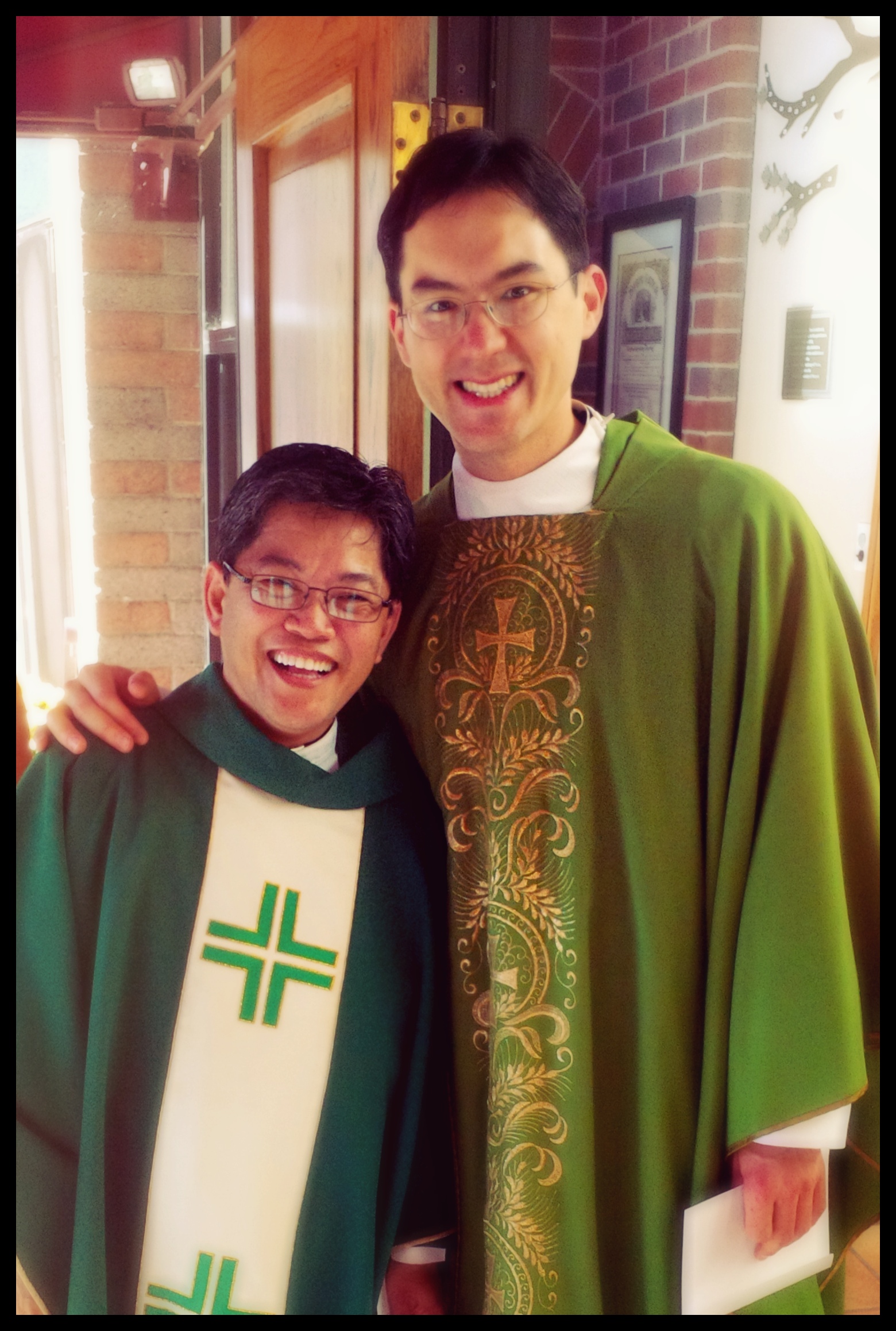 I’m now 46 years old. This is Fr. Mario and I (http://thejustmeasure.ca/wp-content/uploads/2014/07/photo-3-689×1024.jpg) the first day I arrived here 12 years ago. You people have worn me out! And Deacon Andrew looks great, but he’s 105 years old. The Holy Spirit loves all people and looks to the next generation.
Fr. Antoine Laviale runs a student parish in Toulouse, France, where they have 270 people in RCIA! Every three weeks, they need to start a new Alpha because of the demand. A few years ago, he went to Steevy (2:49) and asked him to organize Alpha, and he went and asked eight students to be table hosts. He said it’s easy because they share Jesus by friendship. And now, seven weeks ago, 49 young adults became Catholic, and this lady, Lola (3:37), said, “I know it will be the most beautiful day of my life. Even if one day I get married or… have children, it still won’t be as beautiful as [that day].”
The greatest gift is Jesus, through the Holy Spirit, living in us—divinization. And the Holy Spirit has given each of us a unique way to love others.